Smaller Classes with Fewer Teachers
Teacher Misallocation in South African Primary Schools
Stellenbosch University & Tinbergen Institute
2026-02-02
Introduction
The Class Size Puzzle
Student-Teacher Ratio = 32.5
Experienced Class Size = 43.3
Teachers are employed but not fully deployed.
Decomposing the Gap: STR ≠ Class Size
\[\text{STR} = \frac{\text{SCR}}{\text{TCR}}\]
| Metric | Definition | National Average |
|---|---|---|
| STR | Student-Teacher Ratio | 32.5 |
| SCR | Student-Class Ratio | 39.3 |
| TCR | Teacher-Class Ratio | 1.22 |
TCR = 1.22 → Teachers timetabled for only 82% of periods
Same STR of 30 can mean classes of 30 (TCR=1) or classes of 60 (TCR=2).
Scheduled vs Unscheduled Absence
Key distinction: Not timetabled ≠ Absent when timetabled
World Bank SDI conflates these:
\[\text{Class Absence} = 1 - \frac{\text{Teachers in Classrooms}}{\text{Total Employed}}\]
- 44% of SSA teachers “absent” from class (Bold et al. 2017)
- Of these, 48% are at school but not timetabled
Policy implication: Administrative timetabling reforms ≠ behavioural accountability interventions.
Literature: Four Gaps
1. Misallocation
Focuses on between-school variation (Walter 2020).
My finding: Within-school slack > spatial gains.
3. Input Elasticity
Why hiring fails to improve learning (Hanushek 1986).
My contribution: Hiring → absorbed into slack.
2. Teacher Utilization
TCR “remarkably understudied” (Bennell 2022).
Gap: No rigorous large-scale primary analysis (Tanzania TCR = 2.5).
4. Management
Focuses on talent management (Bloom et al. 2015).
Gap: Overlooks extensive margin of deployment.
Data
- 5.4 million learners in 9,512 public primary schools
- 2023 cross-section; 2018–2023 panel
- Final sample: ≈78% of all public primary learners
Novel feature: Reconstructed class-level timetables from learner-class assignments in administrative data.
Direct measurement of teacher deployment—not survey self-reports.
Measurement Framework
Optimization Framework: Allocative Efficiency
Scope: Optimality is defined here strictly as resource distribution, holding pedagogical models constant.
- The Primal Objective (Policy Preference Maximisation) Minimise Experienced Class Size given fixed staff establishment.
- The Dual Objective (Cost Rationalisation) Minimise Staff Establishment required to meet a specific class size target.
The Measurement Innovation
Core idea: Use constrained optimisation to quantify efficiency gaps.
For each school, I solve:
\[\min_{\{k_g\}} \text{ECS} = \min_{\{k_g\}} \frac{\sum_g n_g^2 / k_g}{\sum_g n_g}\]
subject to progressively relaxed constraints on \(\sum_g k_g\).
The gap between observed and optimal = measurable inefficiency.
By comparing optima under different constraints, I decompose where inefficiency lies:
- Technical (timetabling) vs Allocative (capital vs labour) vs Spatial
The Allocation Algorithm
Objective: Minimise \(\sum_g n_g^2/k_g\) (equivalent to minimising ECS)
Method: Greedy algorithm with max-priority queue—provably optimal (convex objective)
Algorithm:
- Assign one class per non-empty grade
- Calculate marginal gain of adding one class to each grade: \(\Delta = \frac{n^2}{k(k+1)}\)
- Add class to grade with highest gain
- Repeat until all classes allocated
Shadow Price:
After allocation, the shadow price = marginal gain of the next class.
This tells us the value of an additional teacher:
- High shadow price → binding constraint
- Low shadow price → diminishing returns
Shadow prices reveal which schools would benefit most from expansion.
Optimisation as Measurement
I solve for minimum ECS under nested constraints to quantify efficiency gaps.
| Scenario | Constraint | What it measures | Example 🔎 |
|---|---|---|---|
| S0 | Status quo | Baseline | S0 |
| S1–S2 | Balance classes | Technical efficiency | S1, S2 |
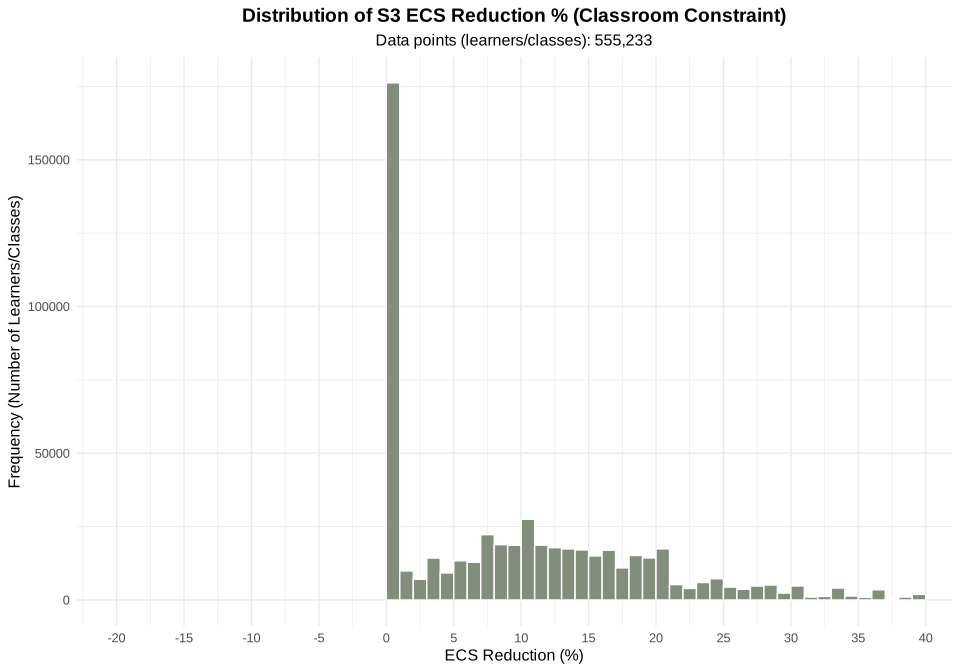
| S3 | Bind by classrooms | Capital slack | S3 |
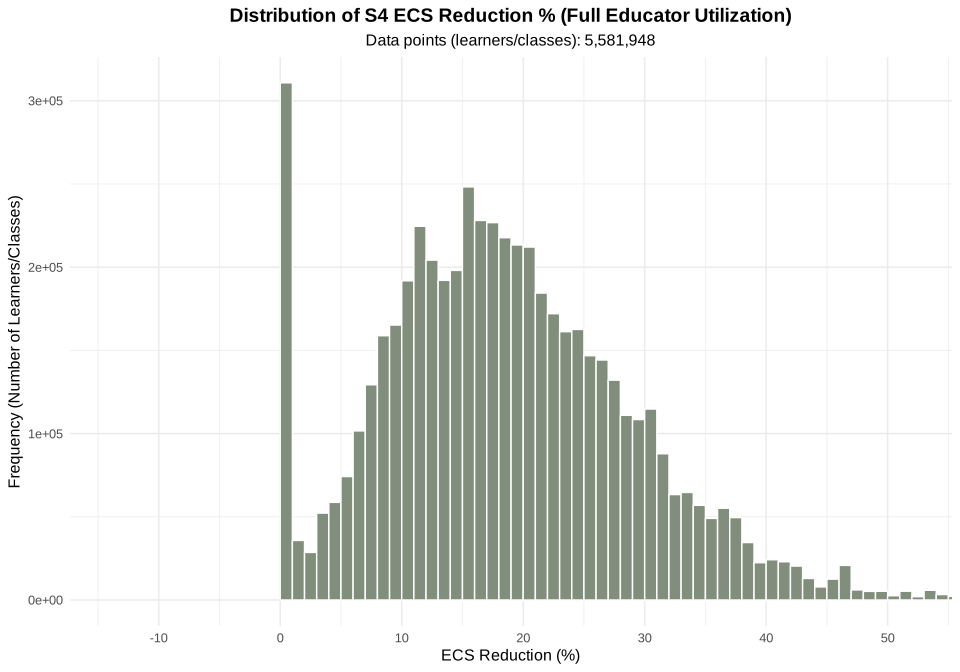
| S4 | Bind by teachers | Labour slack | S4 |
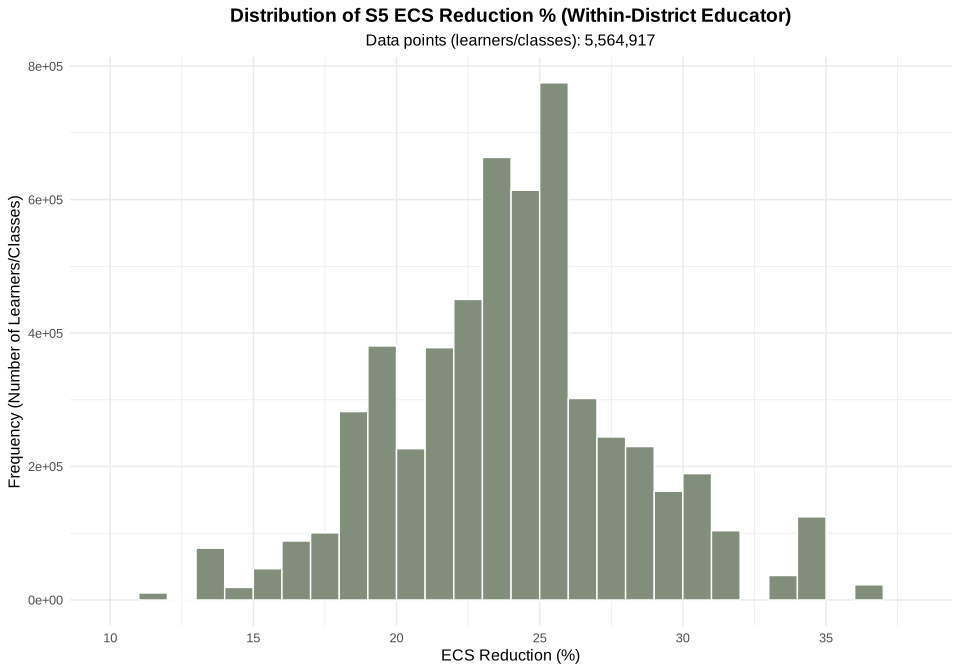
| S5–S6 | Pool across space | Spatial misallocation | S5, S6 |
“Optimal” = minimum class size for given teachers (or equivalently, minimum teachers for given class size).
Gaps in Efficiency Could Close Gaps in Equity
Systematic Patterns in Class Size and Inefficiency
Main Result: Where the Inefficiency Lies
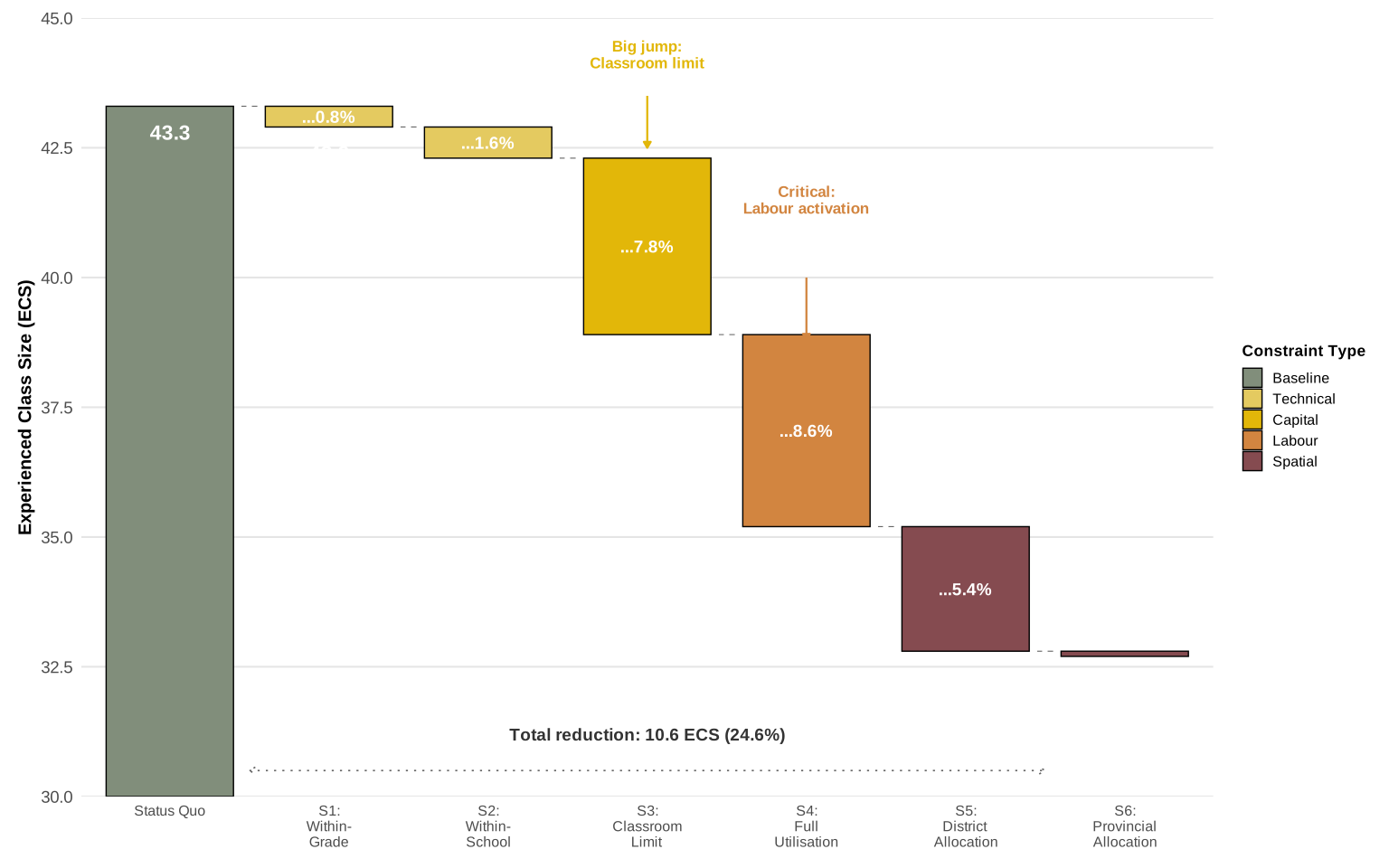
Key Findings: Descriptive
- S4 (full teacher utilisation): −18.8% ECS. Core inefficiency.
- S5 (district pooling): Most spatial gains captured locally.
- S6 (province pooling): Negligible additional benefit (+0.4 pp).
Causal Identification
The Identification Question
Question: Does exogenously providing a school with additional teachers lead to smaller classes or increased slack?
Three sources of bias in OLS:
- Reverse causality: Inefficient schools receive compensatory staffing
- Selection: Management quality affects both staffing and deployment
- Omitted variables: Neighbourhood effects, principal quality, union strength
Solution: Instrument STR with bureaucratic teacher allocation rules (Post Provisioning Norm).
Instrument: Post Provisioning Norm (PPN)
PPN formula: f(enrolment, grade-mix, quintile, provincial norms)
| Grade | Max Class | Weight |
|---|---|---|
| R | 35 | 0 |
| 1–4 | 35 | 1.190 |
| 5–6 | 40 | 1.042 |
| 7 | 37 | 1.126 |
Identification: Within-school grade composition changes trigger mechanical allocation adjustments.
- Schools don’t control cohort composition
- School FE + enrolment controls absorb time-invariant quality
Specification
\[ \begin{aligned} \text{First stage:} \quad & \Delta \text{STR}_{\text{actual}} = \alpha + \beta \cdot \Delta \overline{\text{PPN-Weight}}_{\text{leaver}} + \delta_t + \varepsilon \\[0.5em] \text{Second stage:} \quad & \Delta \text{Inefficiency} = \alpha + \delta \cdot \Delta \widehat{\text{STR}} + \delta_t + \varepsilon \end{aligned} \]
First-differences specification. School-level clustering. N = 28,703 school-years.
Identifying assumptions:
- Relevance: PPN strongly predicts actual STR (F > 60)
- Exclusion: PPN affects inefficiency only through STR
- Exogeneity: Grade-mix changes ⊥ time-varying management quality
IV Results
| First-Differences | |
|---|---|
| 2SLS Coefficient (δ) | −4.5* |
| Standard Error | 0.111 |
| First-stage F-statistic | 60.4 |
| N (school-years) | 28,703 |
Interpretation: Exogenously gaining teachers → increased slack, not smaller classes.
Schools absorb additional teachers into lighter workloads. Why? 🔎
Robustness
Instrument validity: ✓
- Balance on 15 pre-determined covariates
- No pre-trends (future shocks don’t predict past outcomes)
- F > 30 across all specifications
Specification robustness: ✓
- 7 fixed effects combinations
- 4 clustering schemes
- 5 functional forms
Heterogeneity: Effect stronger in small schools, low-STR contexts
Implications
But Isn’t That Slack Needed for Preparation?
The professional day extends beyond instruction
| Component | Description |
|---|---|
| Formal school day | 7 hours at school (PAM requirement) |
| Instructional periods | ~6 periods × 45 min = ~4.5 hours |
| Breaks | Recess + lunch = ~1 hour (rest, not prep) |
| Within-day non-contact | ~1.5 hours (admin, assembly, free time) |
| Informal school day | ~400 hours/year = ~2 hours/day explicitly for preparation |
Key point: The “informal school day” is mandated time outside formal hours for planning and marking.
Even at TCR = 1.0, teachers have ~3.5 hours daily for preparation (1.5h in-day + 2h informal).
Current TCR = 1.22 gives additional free periods during instruction—beyond what’s needed.
Fiscal Leakage
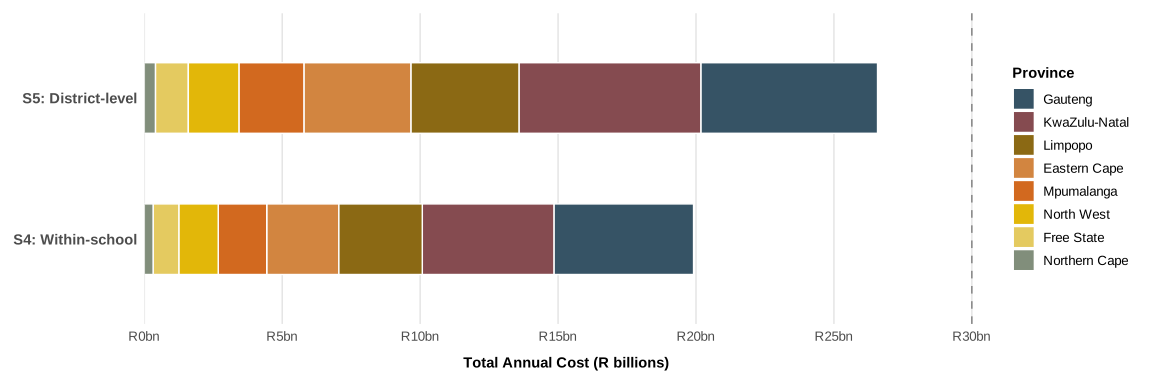
- R22.3bn annually: Cost of S4 teacher under-utilisation (18.2% of time)
- R29.6bn annually: Including spatial misallocation
- Exceeds combined spending on school nutrition + learning materials
Policy Implications
1. Enforce contact-time norms
- −18.8% ECS or free ≈18% educator capacity (≈R22bn)
2. Activate idle classrooms
- −10.2% ECS from capital under-utilisation
3. District-level pooling
- Shift hiring from school to district level
- Captures spatial gains (−24.2% cumulative) without provincial disruption
Key insight: The problem is deployment incentives, not fiscal constraints.
Summary
1. Measurement innovation: Constrained optimisation to quantify efficiency gaps under nested constraints—technical, allocative, spatial.
2. Descriptive finding: Within-school labour slack (−18.8%) > spatial misallocation (−5.8 pp).
3. Causal evidence: Exogenously adding teachers increases slack, not reduces class sizes (δ = −4.5).
4. Policy implication: R22bn annually—deployment reform, not fiscal expansion.
References
Bennell, Paul. 2022. “Teaching Too Little to Too Many: Teaching Loads and Class Size in Secondary Schools in Sub-Saharan Africa.” International Journal of Educational Development 94 (October): 102651. https://doi.org/10.1016/j.ijedudev.2022.102651.
Bloom, Nicholas, Renata Lemos, Raffaella Sadun, and John Van Reenen. 2015. “Does Management Matter in Schools?” The Economic Journal 125 (584): 647–74. https://doi.org/10.1111/ecoj.12267.
Bold, Tessa, Deon Filmer, Gayle Martin, Ezequiel Molina, Christophe Rockmore, Brian Stacy, Jakob Svensson, and Waly Wane. 2017. What Do Teachers Know and Do? Does It Matter? Evidence from Primary Schools in Africa. World Bank, Washington, DC. https://doi.org/10.1596/1813-9450-7956.
Hanushek, Eric A. 1986. “The Economics of Schooling: Production and Efficiency in Public Schools.” Journal of Economic Literature 24 (3): 1141–77. https://www.jstor.org/stable/2725865.
Walter, Torsten Figueiredo. 2020. “Misallocation in the Public Sector? Cross-Country Evidence from Two Million Primary Schools.” Unpublished.
Appendix
Sample Attrition
- Final coverage: ≈5.4 million learners (78%), 9,512 schools
- Largest exclusion: Multigrade schools (≈12%)
- External validity concern: Multigrade schools may face distinct challenges
Fiscal Assumptions
- Baseline: Mean educator salary R42,000/month; 12 months; S4 inefficiency 18.2%
- Sensitivity: ±10% salary → R20.0–24.5bn range
- Coverage: Primary only (R22.3bn); secondary extrapolation ≈R62bn total
- As % of education budget: 7.6–10.1%
Comparison: R22.3bn > National School Nutrition (≈R8bn) + LTSM (≈R12bn)
IV Robustness: Full Table
| # | Category | Test | Description |
|---|---|---|---|
| 1 | Instrument Validity | Balance on observables | Instrument orthogonal to 15 pre-determined covariates |
| 2 | Instrument Validity | Falsification tests | Future PPN shocks don't predict past outcomes |
| 3 | Instrument Validity | Weak instrument robust CI | Anderson-Rubin and CLR confidence sets |
| 4 | Instrument Validity | Reduced form on placebos | No effect on time-invariant school characteristics |
| 5 | Instrument Validity | Exclusion restriction probes | Control for PPN sub-components |
| 6 | Instrument Validity | Overidentification tests | Grade-specific instruments yield consistent estimates |
| 7 | Instrument Validity | First-stage heterogeneity | Strong F-statistics across districts and time periods |
| 8 | Specification Robustness | Alternative fixed effects | None, Year, District, School, Province×Year, District×Year |
| 9 | Specification Robustness | Alternative clustering | School, District, Two-way (School+Year), Two-way (District+Year) |
| 10 | Specification Robustness | Subsample stability | Balanced panel, exclude outliers, by quintile, leave-one-province-out |
| 11 | Specification Robustness | Alternative functional forms | Level-level, log-log, level-log, log-level, quadratic |
| 12 | Specification Robustness | Asymmetry tests | STR increases vs decreases (gains vs losses) |
| 13 | Specification Robustness | Specification ladder | Progressive inclusion of controls and FE |
| 14 | Specification Robustness | Control function approach | Alternative estimator using residuals as control |
| 15 | Heterogeneity Analysis | Effect modification | By school size, initial STR, baseline class size, quintile, urban/rural |
| 16 | Mediation Analysis | Class count as mediator | Tests whether STR affects inefficiency through class formation |
| 17 | Attrition & Sample Selection | Sample attrition tests | Validates representativeness of final sample (78% coverage) |
Demographic Shock Elasticities
Question: Are high TCRs forced by constraints or discretionary?
Test logic: If constraints bind → shocks raise inefficiency. If slack is discretionary → shocks reveal latent capacity.
- β₁ (Grade-Mix) = −0.381*** (10 pp shift → 3.81 pp inefficiency reduction)
- β₂ (Phase-Mix) = −0.256*** (teachers reallocated across phase boundaries)
- All coefficients negative → adaptive capacity exists
Alternative Explanations Ruled Out
17 mechanisms investigated. Five structural rigidities predict β > 0 if binding:
| Mechanism | Prediction | Finding |
|---|---|---|
| Grade-specific match capital | β₁ > 0 | Rejected: β₁ = −0.381 |
| Qualification constraints | β₂ > 0 | Rejected: β₂ = −0.256 |
| Period indivisibilities | β > 0 | Rejected: both < 0 |
| Cross-phase synchronisation | β₂ > 0 | Rejected: β₂ = −0.256 |
| Enrolment volatility buffering | β₃ > 0 | Rejected: β₃ = −0.007 |
Consistent with: Policy equilibria where slack is discretionary.
Caveat: Standby rosters create endogeneity—estimates may be lower bounds.
Equity Implications
- Baseline gap: Q1–Q2 classes 32% larger than Q5
- Paradox: Wealthier schools show largest efficiency gains (−20.2%)—hold more slack
- Implication: Efficiency reforms reduce absolute crowding but preserve relative inequality
Racial Inequality
- Baseline gap: Black learners 29% larger classes than white (44.3 vs 34.4)
- Post-optimisation: Gap persists (33.4 vs 25.8)
- White-learner schools hold more idle capacity
Why Would Schools Choose Inefficiency?
Core mechanism: Teachers value free periods above smaller classes.
- Rigid wage schedules: Non-pecuniary compensation (lighter loads) becomes primary margin
- Union bargaining: Workload norms weakly enforced
- Measurement vacuum: What isn’t measured can’t be managed
- Rational precaution: Standby rosters for unscheduled absence create endogenous slack
Political economy: TCR represents negotiated equilibrium—teachers capture rents through reduced contact time rather than higher wages.
International Comparisons
| Country | TCR | Utilisation |
|---|---|---|
| Tanzania | 2.5 | 40% |
| Ethiopia | ≈1.4 | ≈71% |
| South Africa | 1.22 | 82% |
- Vietnam: Explicitly targets TCR > 1 for extended contact hours
- SSA systems without timetabling software may face both technical and allocative inefficiency
Implication: South Africa’s problem is utilisation (S4), not timetabling (S1–S2).
Algebra Reference
Core Identity: STR = SCR / TCR
- STR = Learners / Teachers
- SCR = Learners / Classes
- TCR = Teachers / Classes
Experienced Class Size (ECS): \[\text{ECS} = \frac{\sum_i \text{CS}_i^2}{\sum_i \text{CS}_i} = \overline{\text{CS}} + \frac{\sigma^2_{\text{CS}}}{\overline{\text{CS}}}\]
Example: Classes of {50, 10} average 30, but ECS = 43.3 (more learners experience the larger class).
Provincial Scenarios
- Limpopo & Eastern Cape: High capital slack (idle classrooms)
- Limpopo & Mpumalanga: High labour slack (idle teachers)
- Provinces need tailored interventions
Representative School: Status Quo (S0)
Baseline timetable at 82nd percentile reducibility. School: 1,220 learners, 27 classes, 7 grades, ECS 47.8.
Within-grade dispersion modest. Between-grade imbalance small. Key: 27 classes but more teachers available.
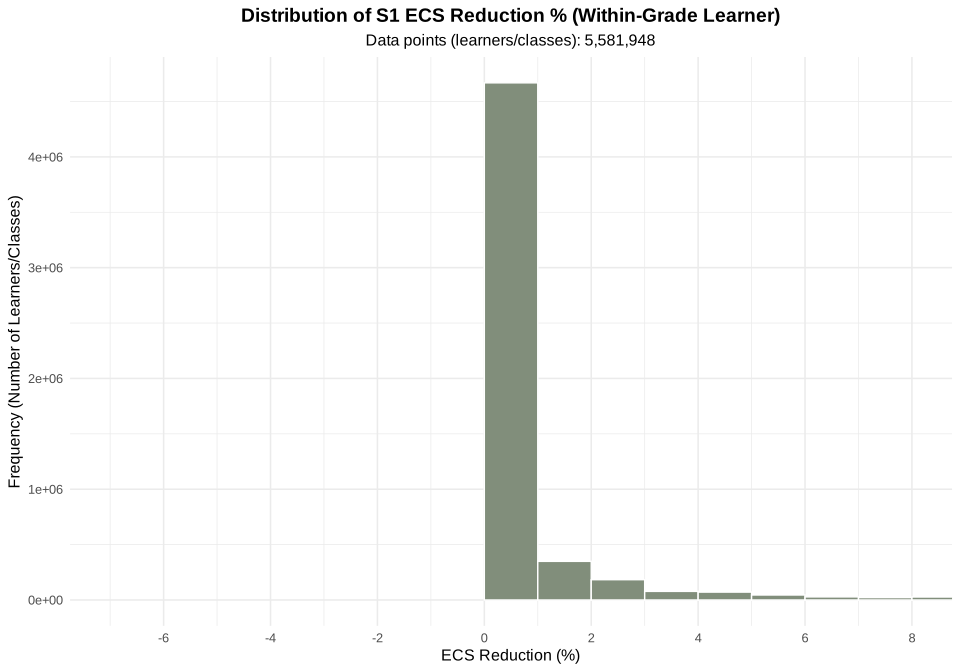
Within-Grade Equalisation (S1)
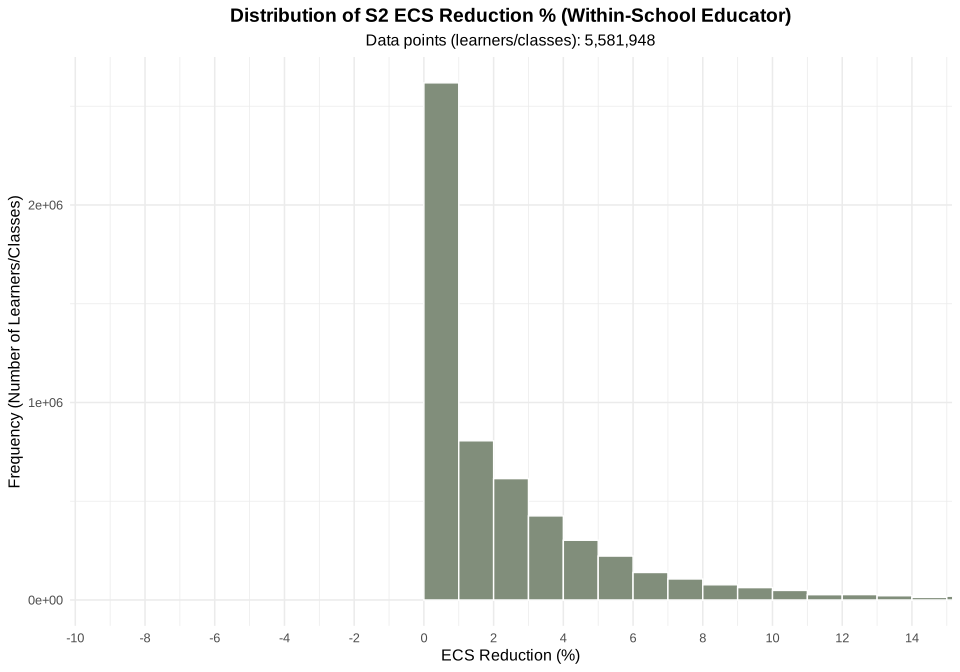
Between-Grade Allocation (S2)
Classroom-Constrained Allocation (S3)
Educator-Optimal Allocation (S4)
District-Level Pooling (S5)
Province-Level Pooling (S6)
Variance Decomposition: What Explains Crowding?
- S4 reducibility: 33.5% of explained variance (R² = 52.3%)
- Traditional factors small: Province 6.3%, Quintile 6.4%, Race 5.5%
- Latent capacity > STR in explaining crowding
Secondary School Extension
- Primary TCR ≈ 1.22 (generalist model). Secondary TCR likely higher:
- Subject specialisation mandated (≈15+ subjects)
- Period indivisibilities bind harder
- Teacher qualifications phase-specific
- Preliminary estimates: If secondary TCR ≈ 1.5, fiscal leakage ≈R40bn additional (total ≈R62bn)
- Data challenge: LURITS lacks subject identifiers for secondary
Policy: Subject rationalisation; pool teachers at district level for rare subjects.